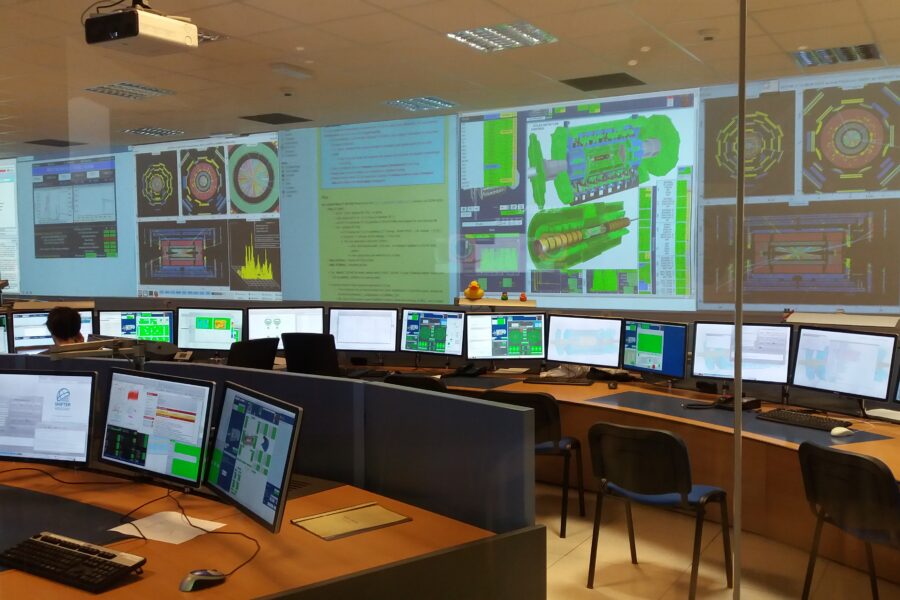
Trusted autonomy depends on more than autonomous performance. It depends on explicit authority, bounded behaviour, resilient communications, evidence and credible human intervention.
Autonomous systems are often discussed in terms of how much a machine can do without direct human control. For high-consequence environments, a more useful question is what authority the system has, under what conditions, with what evidence, and how that authority can be constrained or withdrawn.
01 Executive summary
Autonomy is not a single feature. It is an operating relationship among sensors, software, models, communications, people, procedures and physical systems. A trusted design therefore begins with authority: what actions are permitted, what information is required, which boundaries apply, who can intervene and what happens when the system is uncertain or disconnected.
The design objective is not maximum independence from people. It is controlled delegation. The more consequential the action, the stronger the case for explicit authorization, observable state, resilience under degraded conditions and evidence that allows decisions to be reviewed.
02 Authority before autonomy
Every autonomous workflow should have a defined authority model. What decisions can the system make? Which actions require confirmation? Which conditions narrow or suspend authority? Who can intervene? What happens if communications are lost? These questions should be answered before optimizing autonomous performance.
Authority can also be machine-readable. Identities, roles, permissions, policy rules and task credentials can define which agent or platform is allowed to invoke a function, access data or act within a particular operating envelope. This creates a bridge between governance intent and technical enforcement.
03 Operating envelopes need to be explicit
Autonomous systems perform within assumptions about environment, sensors, communications, available data and task constraints. Trust improves when those assumptions are represented explicitly rather than buried in design documentation. A system should be able to indicate when it is approaching or operating outside the conditions for which its behaviour has been evaluated.
Boundaries can be geographic, temporal, data-related, functional, environmental or authority-based. The important point is that operating limits are observable and connected to defined behaviour. When the system leaves an approved envelope, the response might include slowing, restricting action, requesting confirmation, returning to a safe state or transferring authority.
04 Identity and authorization for machines and agents
Autonomous platforms increasingly combine multiple software components, services and agents. Treating them as anonymous processes makes accountability difficult. A stronger architecture gives people, devices, services and agents explicit identities and assigns authority at the minimum scope required for the task.
Authorization should be revocable and time-bounded where practical. A planning agent may be permitted to propose an action but not execute it. A platform may operate autonomously within a predefined area but require confirmation to expand scope. A maintenance agent may access telemetry but not mission data. These distinctions reduce the risk that one compromised component inherits authority that was never intended.
05 Designing for degraded conditions
High-consequence systems cannot assume perfect connectivity, complete information or healthy sensors. Resilient autonomy should therefore define how behaviour changes when communications, positioning, data feeds, compute resources or other dependencies degrade. The design may reduce capability, shift to a safe state, request human intervention or continue within a narrower pre-authorized envelope.
The assurance question is whether those transitions are defined, tested and observable—not simply whether a nominal mode performs well. Degraded-mode behaviour should be part of requirements and test plans from the beginning rather than added as an exception after integration.
06 Human authority must be technically credible
“Human in the loop” is not a sufficient design requirement. Effective human authority depends on timing, information, interface design and actual control. An operator may need to understand what the system believes, what action it proposes, what constraints are active, whether data or communications are degraded and what alternatives exist.
Intervention also needs a technical path. If an operator can nominally stop a process but the system cannot reliably receive, authenticate or execute that command, the oversight mechanism is weaker than the policy description suggests. Human authority should therefore be tested as a system function.
07 Decision support and operator comprehension
Autonomous systems can create cognitive as well as technical risk. If operators are presented with excessive alerts, unexplained recommendations or rapidly changing state, they may over-trust automation or become unable to intervene effectively. Interface design should prioritize the information needed for a decision: current objective, active constraints, data quality, uncertainty, proposed action, expected effect and available alternatives.
Explanations do not need to expose every internal model parameter. They need to be operationally useful. The system should help a trained operator understand why action is being proposed, which conditions matter and what has changed since the last decision.
08 Communications resilience is part of authority
Autonomous and semi-autonomous systems often depend on networks for tasking, coordination, telemetry, model services or operator intervention. That means communications architecture can determine whether human authority is practical. A trusted design should identify which functions require connectivity, which can continue locally, what state information must be synchronized after disruption and how the system prevents stale or conflicting instructions from becoming a source of risk.
This does not require every component to be permanently connected. In some environments, resilience may depend on deliberately bounded local operation. The important assurance question is whether loss, restoration and degradation of communications are treated as defined system states with tested behaviour.
09 Evidence for autonomous behaviour
Autonomous systems benefit from an evidence model that can reconstruct significant events. Relevant records can include identity and authorization decisions, system configuration, sensor provenance, tasking, state transitions, model versions, human interventions, exceptions and communications status. The goal is not unlimited logging; it is enough evidence to support incident review, assurance and accountable system management.
Evidence should also be protected from alteration and synchronized with configuration management. A post-event record is only useful if reviewers can determine which software, model, policies and permissions were active at the time.
10 Multi-agent systems require bounded coordination
As autonomous architectures evolve toward multiple cooperating agents or platforms, authority can become difficult to reason about. One agent may plan, another may retrieve data, another may control a physical or digital function, and a coordinating service may allocate tasks. Without explicit boundaries, local permissions can combine into system-level authority that no single component was intended to possess.
Multi-agent designs therefore benefit from clear task scopes, authenticated messages, separation of duties, conflict-resolution rules, limits on delegation and observability across agent-to-agent interactions. The system should be able to identify which component made or proposed a consequential decision.
11 Verification should match delegated authority
The strength of evidence should increase with the consequence and autonomy of the function. A low-impact recommendation engine may be evaluated differently from a system that can change configuration, move physical equipment or coordinate other agents. Organizations can use this principle to focus assurance resources: define the authority being delegated, identify credible failure modes, test the relevant boundaries and require enough observability to determine whether those boundaries continue to hold.
Scenario-based evaluation is useful when it tests behaviour against explicitly stated requirements. The purpose is not to prove that every future condition has been anticipated, but to build evidence that the system recognizes uncertainty, respects constraints and fails in a controlled manner when assumptions break.
12 Dual-use implications
Many of the same design principles apply outside defence. Industrial robotics, emergency response, remote inspection, critical infrastructure, logistics and autonomous mobility can all involve systems operating under uncertainty. This creates legitimate dual-use pathways for secure identity, resilient communications, assurance tooling and human-machine control architecture.
Technology transfer should still preserve context. A system developed for a civilian or industrial setting should not be described as defence-qualified merely because the underlying architecture has potential relevance. Readiness, regulation, integration, assurance and information-handling requirements differ substantially by environment.
13 Governance becomes a system property
In mature autonomous architectures, governance is not confined to policy documents. It appears in identity services, permission systems, approval workflows, configuration controls, telemetry, audit trails, interface design and escalation mechanisms. Human accountability is strengthened when organizational rules are reflected in technical controls that can be observed and tested.
A practical review can therefore ask four questions: what authority is delegated, how that authority is technically enforced, what evidence shows that the controls are functioning, and who can change or override them. Those questions connect governance, engineering and operations without requiring one discipline to substitute for another.
14 Research view
Canadian AI Defence frames trusted autonomy around five connected layers: identity and authority; sensing and provenance; planning and control; resilience and degraded-mode behaviour; and assurance with accountable human intervention. The objective is not to eliminate uncertainty, but to make system authority, state and evidence visible enough to manage it.
The design principle is straightforward: autonomy should expand only as quickly as the organization’s ability to define boundaries, verify behaviour, preserve evidence and maintain credible human authority.
15 Selected public references
- DND/CAF Artificial Intelligence Strategy
- NIST AI Risk Management Framework
- Summary of NATO’s Revised Artificial Intelligence Strategy
This article discusses high-level system design, governance and assurance. It does not provide instructions for weapons employment, targeting or operational military activity.